

NETlab Research Notes and a Technical Review of Production Processes
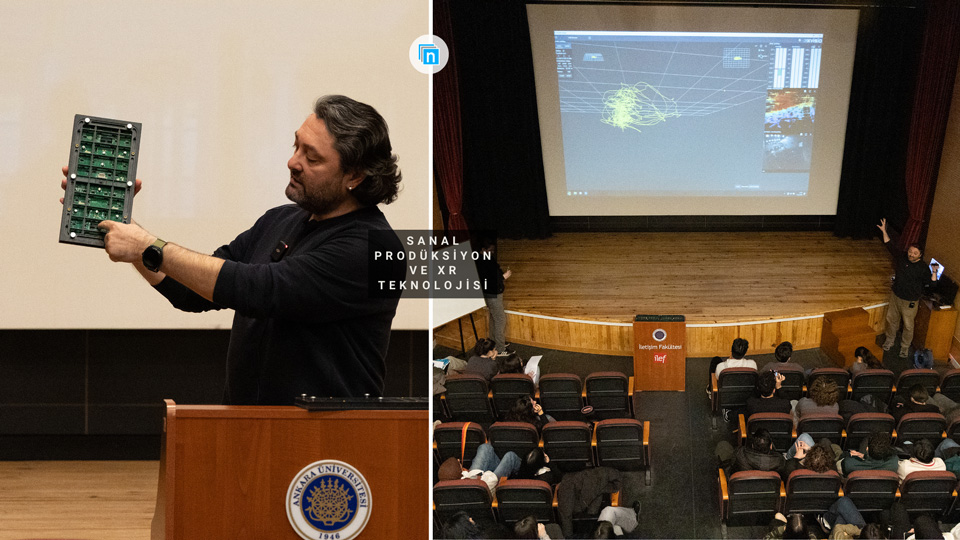
At the workshop held by NETlab on December 4, 2025, VP Supervisor and Technical Director Emre Şan discussed virtual production (VP) technologies, which are becoming increasingly prevalent in the cinema and television industry, through both technical and sectoral lenses. Şan characterized virtual production not merely as a "new filming technique," but as an ecosystem that is fundamentally transforming production workflows.
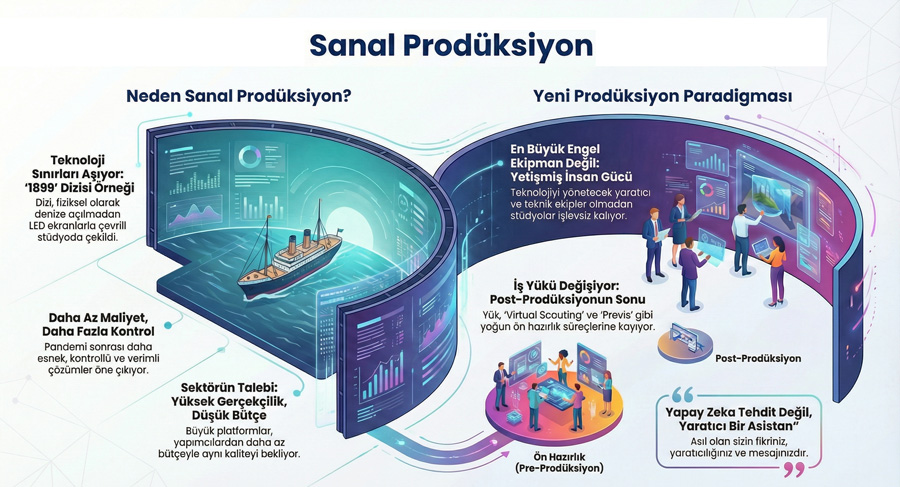
Addressing why virtual production is spreading so rapidly on a global scale, Şan emphasized that the post-pandemic era has pushed production processes toward more cost-effective, flexible, and controlled solutions. Noting that major platforms now demand "the same level of realism with smaller budgets," Şan stated that virtual production has become one of the most powerful tools to meet this expectation. In this context, the fact that the majority of the episodes of 1899 was filmed in a studio environment surrounded by LED screens—without ever physically going out to sea—was shared as a prime example of the technology's current capabilities.
Creative Human Capital is as Vital as Technology
One of the key takeaways from the seminar was that the greatest obstacle facing virtual production infrastructure in Turkey is not technological equipment, but skilled labor. Emre Şan emphasized that LED screens, camera systems, and software mean nothing on their own; without teams that understand, manage, and transform these systems into production, studios remain non-functional. Stating that studios built with high budgets cannot be sustainable without the formation of necessary technical and creative staff, Şan pointed out that universities and educational environments must play a critical role at this juncture.
LED Screens and Light Sources in XR Technology
Sharing the technological components of virtual production with the participants, Emre Şan evaluated the systems used under the heading of "Extended Reality (XR)." Şan explained that in XR technologies, the actors and the physical set are real while the background is digitally generated; this overcomes spatial limitations and significantly reduces logistical costs. He highlighted that the modular structure of LED screens allows them to function not just as a background but also as the primary light source for the scene, which is a fundamental element in increasing the sense of realism. On this subject, Şan noted that the direct reflection of color and light values from the digital background onto the actor largely eliminates the "artificiality" issue frequently encountered in post-production.
The End of Post-Production: Everything is Real-Time
Asserting that the greatest revolution of virtual production is the elimination of the traditional post-production process, Şan said, "The moment you shoot the scene, it is ready for broadcast; there is no editing, compositing, or VFX afterward." However, he noted that this requires a very rigorous pre-production process, where every detail must be prepared in a digital environment weeks before the shoot using methods such as Virtual Scouting and Previs.
Another point emphasized by Emre Şan was the shift of the operational load from post-production to pre-production. Thanks to processes like Virtual Scouting, Pre-visualization and scene planning, scenes are designed in the digital environment beforehand and are produced in a "near-final" state during the shoot. While this lightens the post-production burden, it necessitates a much more disciplined, lengthy, and meticulously planned pre-production phase.
AI is a Tool; Creativity Remains Paramount
Evaluating the impact of artificial intelligence on virtual production, Emre Şan emphasized that this technology is not a threat, but rather an assistant that accelerates the process. He noted that while AI provides ideas during scene sketching or concept design, physical tasks such as lighting management and camera operation still depend on human expertise. Şan remarked, “AI cannot end this industry; what matters is your idea, your creativity, and your message,” highlighting that no matter how advanced technology becomes, the core power that forms the whole is the idea originating from the human mind.
Touching upon AI’s role in virtual production workflows, Şan described it as a tool that enhances the creative process rather than a replacement. He pointed out that while AI offers significant contributions to concept development, scene design, and visual ideation, fundamental elements like lighting, camera work, physical space, and narrative still rely on human creativity. He reminded the audience that despite technological advancements, the idea and the message always remain at the heart of the narrative.
Within this vision that centers on the human and the story, the event demonstrated that virtual production is not merely a technical innovation, but a multi-layered field that radically transforms education, employment, and production practices.
This article was prepared by Şafak Dikmen, based on the technical information and sectoral observations presented by Emre Şan during the workshop titled "Virtual Production: Theory to Practice with LED XR". The workshop was held on December 4, 11, and 18, 2025, as part of the NETlab New Media Research Laboratory Technology Seminars. Various artificial intelligence tools were utilized in the production of the visual and written content.
We would like to extend our gratitude to Emre Şan, Kağan Daldal, and the KuleXR Studios & HUB team for their invaluable contributions.
#EmreŞan #VirtualProduction #CinemaTechnologies #NETlab #AnkaraUniversity #XR #UnrealEngine #ArtificialIntelligence